
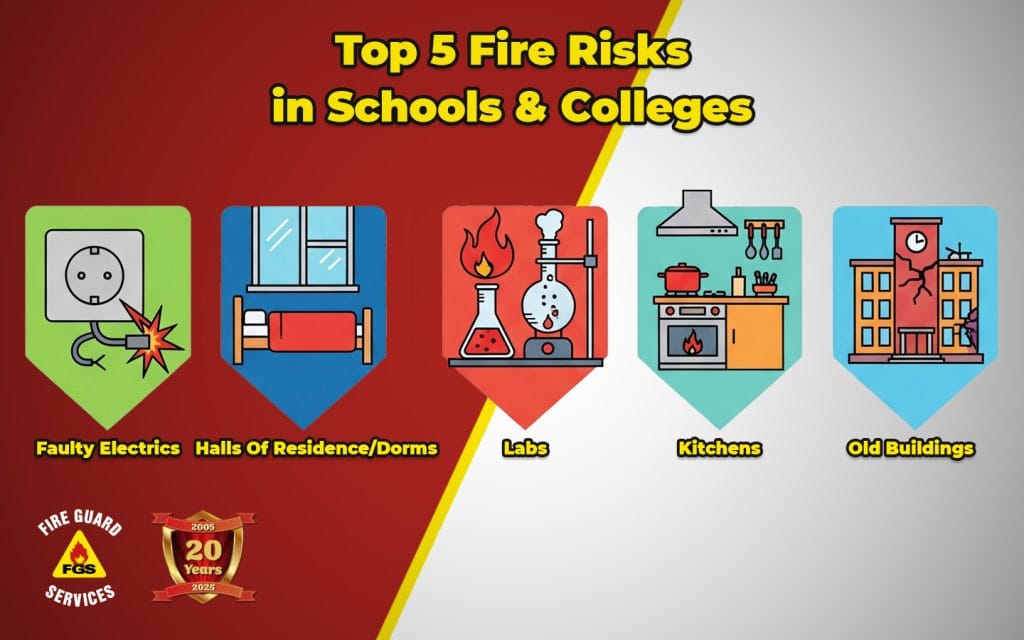
Every headteacher, estates manager, and business manager knows that fire safety in schools and colleges is about much more than compliance – it’s about protecting lives. From nurseries with young children to universities with large campuses, each educational environment faces unique risks. Yet across the sector, many institutions struggle with ageing infrastructure, budget constraints, and evolving regulations.
In this article, we highlight the most common fire safety challenges in education and show how alarms, extinguishers, risk assessments, and training can help create a safe, compliant learning environment while meeting all legal requirements in England.
Book your fire safety review
Get in touch by email or phone for advice
Contact us
Why Fire Safety Is Critical in Education
Educational institutions present particular challenges when it comes to fire safety:
- Large numbers of young or vulnerable people – pupils may need extra assistance during evacuations.
- Complex layouts – multi-building campuses and older facilities with extensions can make safe evacuation more difficult.
- High-risk areas – science labs, design & technology workshops, and commercial kitchens all bring additional hazards.
- Dormitories and boarding houses – sleeping accommodation increases the importance of early detection.
- Budget pressures – schools often face tough choices when allocating resources.
Failure to manage these risks can lead to fines, reputational damage, and – most importantly – harm to students and staff.
Who We Help
Fire Guard Services supports a wide range of educational settings with practical, compliant and reliable fire safety solutions. Whether you manage a single nursery, a busy school site or a multi-building university campus, our team can help you protect pupils, students, staff and visitors while meeting your legal fire safety responsibilities.
We work with:
- Nurseries and early years settings
- Primary and secondary schools
- Academies and multi-academy trusts
- Independent and private schools
- Colleges and further education providers
- Universities and higher education campuses
- Boarding schools and residential education settings
Every education environment has its own fire risks, from classrooms, kitchens and science labs to assembly halls, dormitories, workshops and communal areas. We provide clear advice, dependable servicing and professional support to help you stay compliant, reduce risk and maintain a safe learning environment.
Fire Alarm Systems for Education Settings
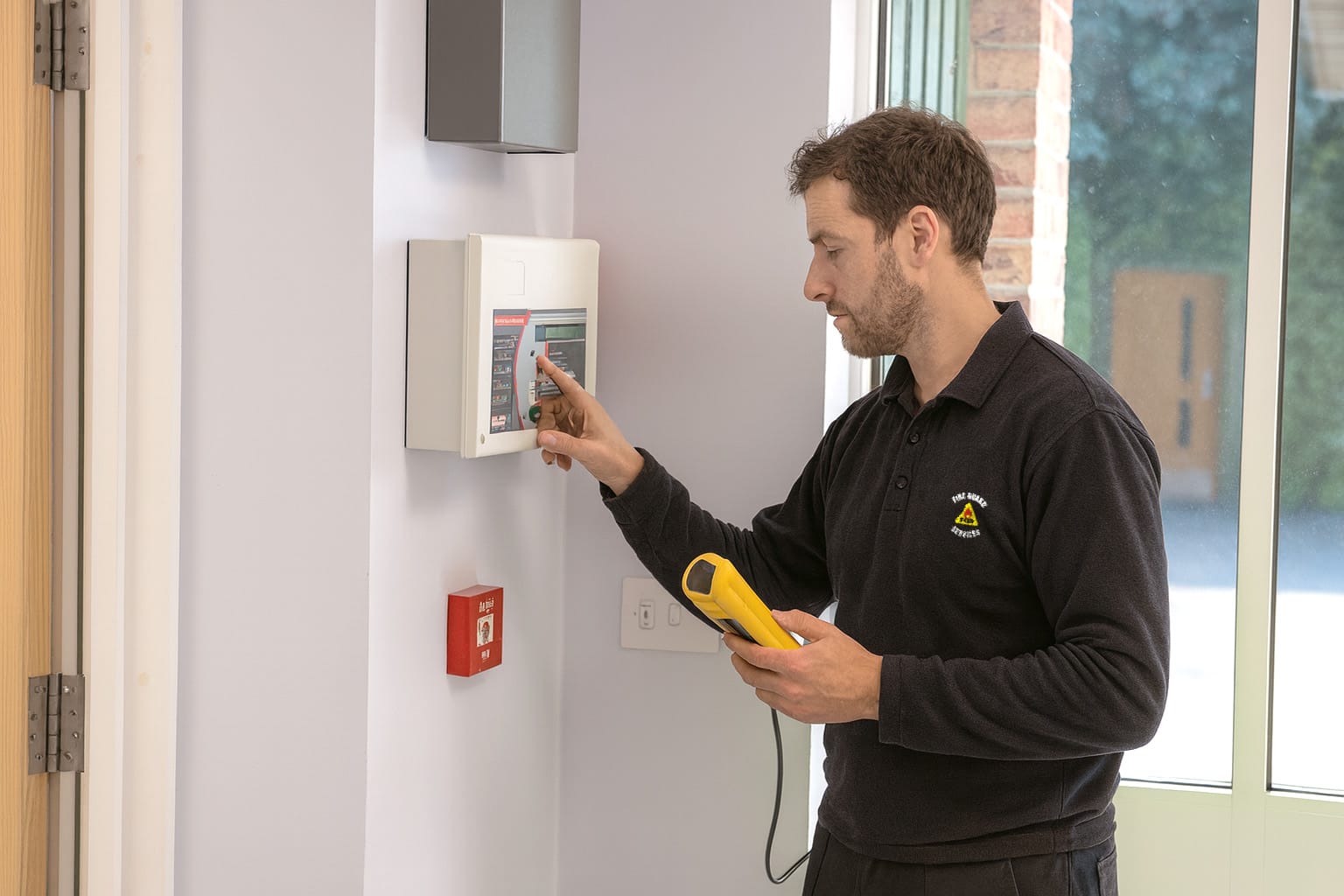
Modern fire alarm systems are essential for protecting schools, colleges, and universities. Key considerations include:
- Automatic smoke and heat detection in classrooms, corridors, and dormitories.
- Addressable fire alarm panels that allow staff to quickly identify where an alarm has been triggered.
- Monitored alarm systems to ensure alerts are raised even outside school hours.
- Regular servicing and testing to maintain compliance and reliability.
For older buildings, wireless systems can be installed with minimal disruption and without damaging heritage interiors.
Fire Extinguishers and Emergency Equipment
Fire extinguishers remain a first line of defence in schools and colleges. Typical requirements include:
- Water or foam extinguishers for corridors and classrooms.
- CO₂ extinguishers for computer rooms and IT suites.
- Specialist extinguishers (such as wet chemical units) for kitchens.
Emergency lighting, fire signage, and clear escape routes also play a vital role in ensuring students and staff can leave buildings safely.
Fire Risk Assessments in Schools and Colleges
Under the Regulatory Reform (Fire Safety) Order 2005, every educational institution must carry out a fire risk assessment. This should review:
- Evacuation routes and accessibility for students with SEND (special educational needs and disabilities).
- High-risk areas such as labs, workshops, and kitchens.
- Adequacy of alarms, extinguishers, and emergency lighting.
- Staff training and student awareness programmes.
- Fire door compliance and compartmentation.
Assessments should be reviewed annually, or whenever significant changes are made to the premises.
Training Teachers, Staff, and Students

Fire Training is essential for ensuring everyone knows what to do in an emergency. Schools and colleges should provide:
- Fire warden training for key staff.
- Evacuation drills at least once per term.
- Awareness sessions for staff and students, including how to raise the alarm and respond safely.
- Special procedures for boarding schools and SEND students.
Practical, engaging training ensures confidence and reduces panic during real incidents.
Why Proactive Fire Safety Matters in Education
Effective fire safety means peace of mind. With modern alarm systems, properly maintained extinguishers, regular risk assessments, and well-trained staff, schools and colleges can meet legal requirements and – most importantly – keep children and young people safe.
Partnering with an experienced provider like Fire Guard Services ensures that compliance is maintained year-round and that institutions receive tailored, cost-effective support. So if you need help or guidance with your fire safety in schools and colleges or other educational establishment around the following areas, please feel free to get in touch.
Fire prevention and protection services for education
Fire Guard Services provides practical fire safety support for schools, colleges, nurseries, academies, independent schools, boarding schools and university campuses. From routine servicing to compliance-led risk assessments, we help education providers protect pupils, students, staff and visitors while meeting their legal fire safety responsibilities.
As a busy School Business Manager it’s important to have reliable and knowledgeable contractors to help keep the school safe for our children. Fire Guard Services always offer us peace of mind that all aspects of our fire security systems are maintained in line with regulatory requirements. They also offer value for money, quality services which demonstrates they understand the education sector.
Sarah Murdoch, School Business Manage
Hillshott Infant School and Nursery
★★★★★

Identify fire hazards, assess risk levels and receive clear, practical recommendations to help keep your education setting compliant and safe.

Installation, maintenance and servicing of fire alarm systems for classrooms, corridors, halls, kitchens, laboratories, accommodation blocks and communal areas.

Give staff the knowledge and confidence to respond effectively in an emergency, support evacuations and understand their fire safety responsibilities.

Supply, servicing and maintenance of fire extinguishers suitable for education environments, including classrooms, kitchens, workshops, offices and communal spaces.
Portable appliance testing to help reduce electrical fire risks across classrooms, offices, staff rooms, kitchens, IT suites and shared learning spaces.

Testing, maintenance and support for emergency lighting systems, helping ensure escape routes remain visible during power failure or emergency evacuation.

Fire door inspections and remedial support to help maintain compartmentation, protect escape routes and reduce the spread of smoke and fire.
Clear, compliant fire safety signage for escape routes, fire exits, assembly points, extinguisher locations and high-risk areas across education settings.
FAQs: Fire Safety in Schools, Colleges and Universities
Who is responsible for fire safety in a school or college?
Fire safety is usually the responsibility of the “Responsible Person”. In an education setting, this may be the employer, headteacher, trust, governing body, site manager, facilities manager or another person with control over the premises. The Responsible Person must make sure suitable fire safety arrangements are in place, including a fire risk assessment and appropriate precautions to protect pupils, students, staff and visitors. GOV.UK provides guidance on identifying Responsible Persons and Duty Holders under fire safety law.
Do schools and colleges need a fire risk assessment?
Yes. Schools, colleges and other education premises should have a suitable and sufficient fire risk assessment. UK guidance states that the Responsible Person must carry out and regularly review a fire risk assessment, and must keep a written record of it.
How often should a school fire risk assessment be reviewed?
A school fire risk assessment should be reviewed regularly and whenever there are significant changes to the premises, occupancy, building layout, fire safety systems, use of rooms or site operations. For example, a review may be needed after refurbishment works, changes to escape routes, new classroom layouts, increased pupil numbers or changes involving laboratories, kitchens, workshops or accommodation areas.
FAQWhat fire safety equipment do schools and colleges need?
The equipment required will depend on the findings of the fire risk assessment. Most education settings will need appropriate fire alarm systems, emergency lighting, fire extinguishers, fire safety signs, clear escape routes and suitable fire doors. Larger or higher-risk sites may also need additional measures depending on the layout, occupancy and use of the building.
Do schools need fire alarm servicing?
Yes. Fire alarm systems in schools, colleges and universities should be properly tested, serviced and maintained to make sure they work when needed. Regular maintenance also helps identify faults early, reduce false alarms and support ongoing compliance.
Do fire extinguishers in schools need to be serviced?
Yes. Fire extinguishers should be inspected and serviced by a competent person to make sure they are correctly located, suitable for the risks present and ready for use in an emergency. This is especially important in higher-risk areas such as kitchens, science labs, workshops, plant rooms and communal spaces.
Do school staff need fire safety training?
Yes. Staff should understand their fire safety responsibilities, evacuation procedures, alarm arrangements and what to do in an emergency. Fire warden or fire marshal training may also be required for designated members of staff. Training is particularly important in education settings where pupils, young children, visitors or people with additional needs may require support during evacuation.
How often should schools carry out fire drills?
Schools should carry out regular fire drills so pupils, students and staff understand what to do in an emergency. The frequency should be informed by the fire risk assessment, the type of setting and the needs of the people on site. Boarding schools, nurseries, SEND settings and larger campuses may require more detailed evacuation planning.
Are fire doors important in schools and colleges?
Yes. Fire doors play a vital role in slowing the spread of smoke and fire, protecting escape routes and supporting safe evacuation. They should be kept in good condition, close properly and never be wedged open unless fitted with suitable approved hold-open devices connected to the fire alarm system.
Do schools need emergency lighting?
Emergency lighting is important because it helps pupils, students, staff and visitors find escape routes if normal lighting fails. It is especially important in corridors, stairwells, halls, assembly areas, toilets, plant rooms and any areas used outside normal daylight hours.
Are fire safety signs required in schools?
Fire safety signs help people identify escape routes, fire exits, assembly points, fire alarm call points and fire extinguisher locations. They are particularly useful in education settings where visitors, supply staff, contractors, parents or students may be unfamiliar with the building layout.
Can Fire Guard Services help during school holidays?
Yes. School holidays are often an ideal time to arrange fire risk assessments, fire alarm maintenance, extinguisher servicing, emergency lighting checks, fire door inspections, fire safety signage updates and PAT testing. This can help reduce disruption during term time and ensure the site is ready before pupils and staff return.
Does Fire Guard Services work with academies, independent schools and universities?
Yes. Fire Guard Services supports nurseries, schools, academies, colleges, independent schools, boarding schools and universities with fire prevention and protection services. We work across Bedfordshire, Buckinghamshire, Cambridgeshire, Essex, Hertfordshire, London, Northamptonshire and beyond.
How can we arrange a fire safety review for an education setting?
You can contact Fire Guard Services to discuss your site, the type of education setting you manage and the fire safety services you require. Our team can advise on fire risk assessments, alarm servicing, extinguisher maintenance, emergency lighting, fire safety signs, fire doors, staff training and PAT testing.
Need a fire risk assessment for a school or college?
Contact us today for an immediate quote
Get a quote