
Plug-In Solar Panels Are Now Legal, But What Do They Mean for Fire Safety?
Plug-in solar panels became legal to buy and use across Great Britain(opens in new tab) on 27 August 2026, opening up solar generation to many people who cannot install a conventional rooftop system.
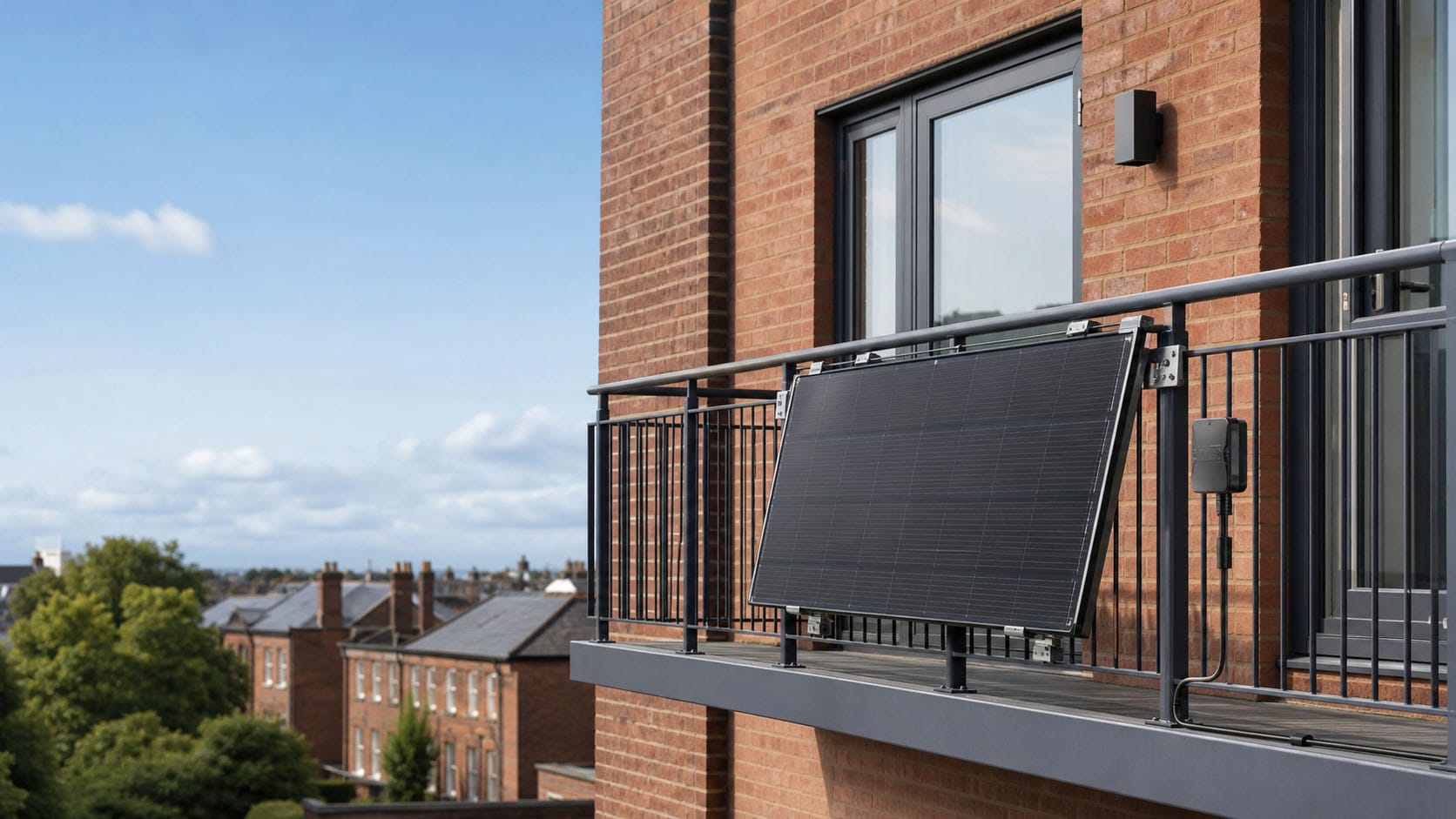
Also known as balcony solar, these products allow a small photovoltaic system to feed electricity into a property through a standard socket. Compliant household kits are limited to a maximum output of 800 VA and could supply up to 20% of an average home’s electricity use.
Making renewable energy more accessible is a welcome development. However, “plug-in” must not be mistaken for “risk-free”.
Electrical Safety First, London Fire Brigade(opens in new tab) and other fire-safety organisations(opens in new tab) have already highlighted questions about unsuitable electrical installations, poor-quality products, unsafe positioning and improper use.
So, what should homeowners, landlords, responsible persons and businesses consider before plug-in solar becomes commonplace?
What has changed?
The government has amended the regulatory framework so that an approved plug can be used to connect a compliant plug-in solar microgenerator to a standard socket.
The change is tightly defined. The current interim product specification:
- Applies to plug-in solar intended for domestic premises
- Limits output to no more than 800 VA
- Permits only one plug-in solar product per household
- Requires products to meet specific electrical and safety requirements
- Does not cover plug-in batteries or solar products incorporating battery storage
This does not mean any solar panel bought online can safely or legally be connected to a property.
Only products meeting the government’s interim product specification should be used. Owners should also follow the manufacturer’s instructions, network-notification requirements, planning rules and any conditions imposed by a landlord, freeholder, managing agent or insurer.
The electrical regulations apply across Great Britain. Separate changes to permitted-development rights in England have clarified where domestic panels may be positioned, including restrictions intended to prevent installation on certain timber structures and cladding.
What are the principal fire risks?
Government testing found that representative systems could operate safely under the conditions examined. Nevertheless, product quality, the condition of the property and the way a system is used remain important.
Potential hazards include:
Overloaded or unsuitable circuits
A plug-in solar system supplies electricity into wiring that may not originally have been designed for this purpose. Older installations, damaged wiring or unsuitable protective devices require particular attention.
Electrical Safety First(opens in new tab) recommends having the installation checked by a registered, competent electrician before purchase, especially in an older property or where the type and condition of the consumer unit and RCD protection are unknown.
It currently recommends at least a Type A bidirectional RCD on the circuit concerned. A home with a Type AC RCD should not use plug-in solar without first obtaining competent advice and, where necessary, upgrading the protection.
Extension leads and adaptors
A plug-in solar system should never be connected through:
- An extension lead or cable reel
- A multiway adaptor
- A travel adaptor
- A plug-in RCD adaptor
- A damaged, loose or unsuitable socket
These accessories can overheat, become overloaded or introduce additional points of failure.
Weather and water ingress
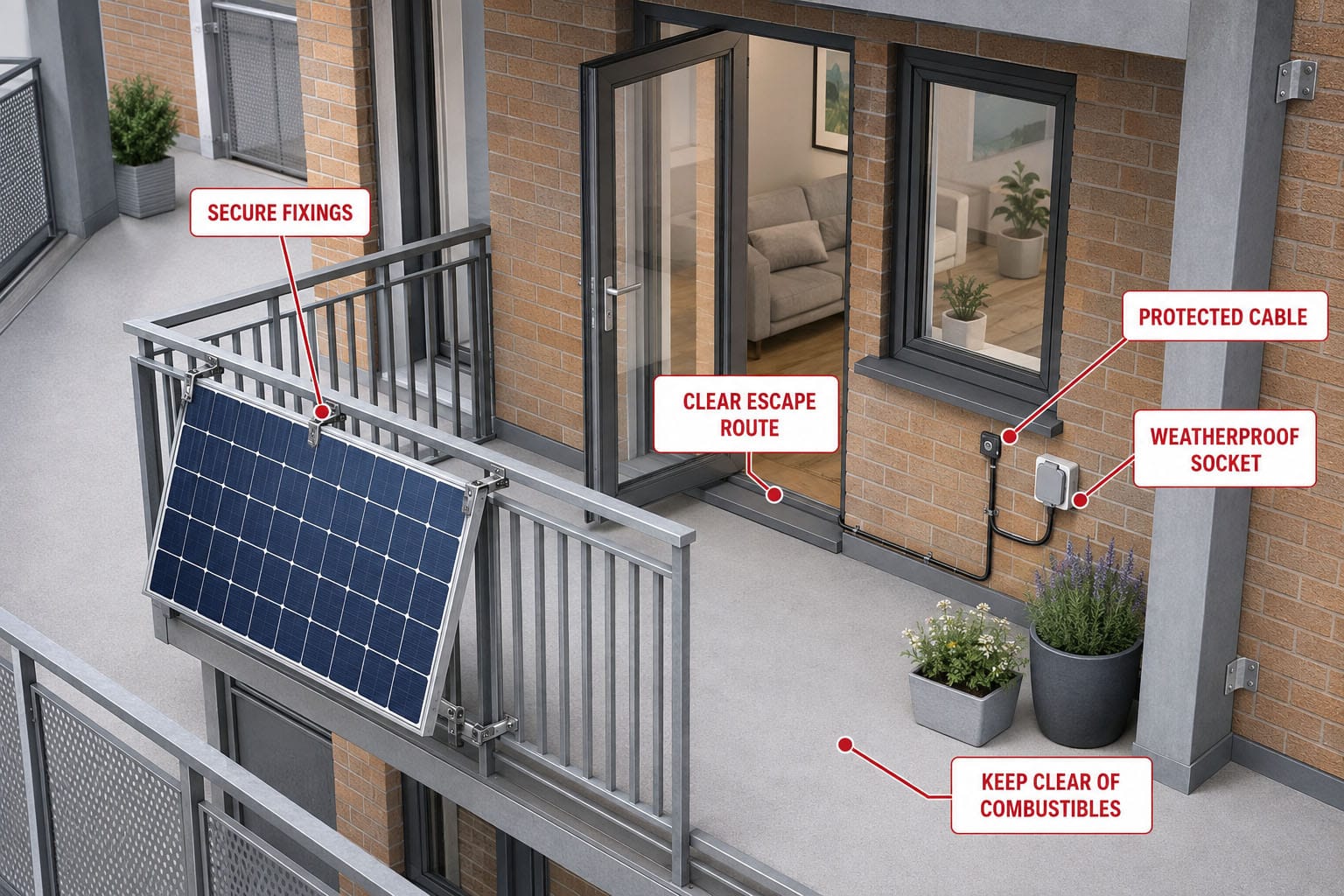
Where an outdoor socket is required, London Fire Brigade recommends a minimum IP65-rated installation fitted by a competent person.
Cables should be protected from damage and must not be trapped in windows or doors, run under carpets or exposed to sharp edges.
Combustible materials and external walls
Panels, microinverters, plugs and cables should be kept away from combustible materials. Plug-in solar should not be mounted on combustible external wall systems or timber balconies.
Panels must also be secured using the manufacturer’s approved brackets and fixings. Improvised mounting arrangements can fail, obstruct escape routes or allow equipment to fall.
Equipment that remains live in daylight
Solar panels can continue generating electricity whenever sufficient light is present, even if the power has been switched off inside the property.
This creates an additional hazard for occupants, maintenance contractors and firefighters. In an emergency, people should leave the property, call 999 and tell the operator and attending firefighters that solar panels are present.
Counterfeit or non-compliant products
Low-cost equipment from an unknown marketplace seller may not meet the interim specification or expected UK safety requirements.
Buy from a reputable supplier, confirm that the complete system is compliant and do not mix components unless the manufacturer specifically permits it.
What does this mean for homeowners?
A compliant system should not automatically require an entirely new household fire-safety installation. It is, however, a good reason to review the precautions already in place.
Before installing plug-in solar, homeowners should ask:
- Is the electrical installation in good condition?
- Is the circuit protected by an appropriate RCD?
- Is the proposed socket suitable and weatherproof where necessary?
- Can the panels be positioned away from combustible materials?
- Will panels, cables or fixings obstruct a window, balcony, walkway or escape route?
- Are smoke alarms installed, working and regularly tested?
- Does the insurer need to be notified?
- Can emergency responders easily be told where the equipment is located?
- Has the Distribution Network Operator been notified within the required period?
Warning signs such as a burning smell, unusual heat, buzzing, visible damage or repeated tripping should never be ignored. Stop using the system immediately and contact the supplier, installer or a competent electrician. If there is a burning smell or any sign of fire, evacuate and call 999.
What about rented homes, flats and other residential buildings?
Plug-in solar raises wider questions in rented and multi-occupied buildings because an installation can affect more than one household.
Tenants should obtain permission from their landlord, housing provider or freeholder before buying or installing equipment. Consent may be required under the tenancy or lease, while unauthorised equipment could affect insurance, building-safety arrangements or planned cladding work.
For landlords, managing agents and responsible persons, a sensible management process should include:
- A clear policy governing whether installations are permitted
- Approval of the proposed product, location, socket and mounting method
- Confirmation that the building’s electrical installation is suitable
- Checks for combustible cladding, timber balconies and vulnerable external-wall systems
- Protection of shared balconies, walkways, windows and escape routes
- Recording each approved installation and its location
- Updating emergency plans and information available to firefighters
- Including the equipment in inspection, maintenance and tenancy-management arrangements
- Reviewing the building’s fire risk assessment where the installation could affect common parts or general fire precautions
Installation may need to be postponed where a building is awaiting cladding remediation or other significant external-wall work.
Existing duties do not disappear. In rented homes in England, landlords must continue to provide the required smoke alarms, keep the electrical installation safe and comply with any additional requirements applying to HMOs, blocks of flats or other regulated accommodation.
Do commercial fire risk assessments need to change?
The current interim specification is intended for domestic premises. Businesses should therefore not assume that the new household plug-in framework authorises the same type of installation in an office, shop, warehouse or other commercial building.
Nevertheless, plug-in solar may still affect commercial responsibilities. A business could occupy part of a mixed-use building, manage residential accommodation, operate serviced apartments or discover that equipment has been introduced by an employee or tenant.
Under the Regulatory Reform (Fire Safety) Order 2005(opens in new tab), the responsible person for non-domestic premises must carry out and regularly review a suitable and sufficient fire risk assessment.
Where solar equipment is proposed or discovered, the review should consider:
- Whether the product is appropriate and legally suitable for the premises
- The condition and capacity of the electrical installation
- Possible ignition sources and combustible materials
- The effect on external walls, roofs and compartmentation
- Escape routes and firefighter access
- Isolation arrangements and emergency procedures
- Fire-detection and warning coverage
- The suitability and position of firefighting equipment
- Inspection, maintenance and defect-reporting procedures
- Training and information for employees, residents and contractors
- Coordination with the landlord, managing agent and other occupiers
The findings and resulting actions should be recorded. For anything beyond a straightforward domestic installation, advice should be obtained from a competent electrician, fire risk assessor and, where relevant, the insurer and building-control or planning authority.
Will additional smoke or heat detection be needed?
Not automatically. Detection must be based on the building, the equipment’s location, occupancy and the findings of the fire risk assessment.
For a typical home, the priority is to ensure that suitable smoke alarms are already installed, correctly located, interconnected where appropriate and tested regularly. Heat detection may be more appropriate in locations where smoke alarms would be prone to false alarms, but it should form part of a properly designed domestic alarm system.
Landlords, HMOs, blocks of flats and commercial premises may require more extensive detection and warning systems. If solar equipment is positioned in a plant area, roof space or another location not adequately covered by the existing system, a competent fire-alarm specialist should assess whether coverage needs to be extended.
A detector should not be placed outdoors or immediately beside equipment simply as a token measure. It must be suitable for the environment and capable of providing a useful warning to the people at risk.
Do we need a special solar-panel fire extinguisher?
There is no universal requirement to place a new extinguisher beside every plug-in solar panel.
For domestic occupants, the safest action when a solar or electrical fire is suspected is normally to get out, stay out and call 999. Occupants should not put themselves at risk trying to fight a fire involving equipment that may remain energised in daylight.
Water should not be used on live electrical equipment.
In commercial premises, carbon dioxide extinguishers are commonly used for electrical risks. However, CO₂ provides little cooling, so a fire can reignite, and it is not appropriate for every environment or every stage of a developing fire. Powder can also be effective on electrical equipment but may impair visibility, affect breathing and cause substantial contamination, making it generally unsuitable for many occupied indoor spaces.
The correct type, number and position of extinguishers must therefore be determined through the fire risk assessment and selected by a competent fire-extinguisher provider. Equipment must then be commissioned, inspected and maintained, with designated staff trained in its safe use.
An extinguisher should never be treated as the solution to unsuitable wiring, unsafe mounting or non-compliant equipment.
What other protective measures should be considered?
Depending on the property and assessment, appropriate controls may include:
- A competent electrical inspection
- Suitable bidirectional RCD protection
- An appropriately rated outdoor socket
- Approved, non-combustible mounting arrangements
- Effective smoke or heat detection
- Clear electrical-isolation information
- Warning labels or building information for maintenance teams
- Updated emergency and evacuation plans
- Suitable commercial firefighting equipment
- Regular visual checks of panels, plugs, cables and fixings
- A process for reporting overheating, damage or electrical tripping
- Staff, resident or tenant information
- Updated records for firefighters and other emergency responders
Our view: accessible technology needs informed fire-safety management
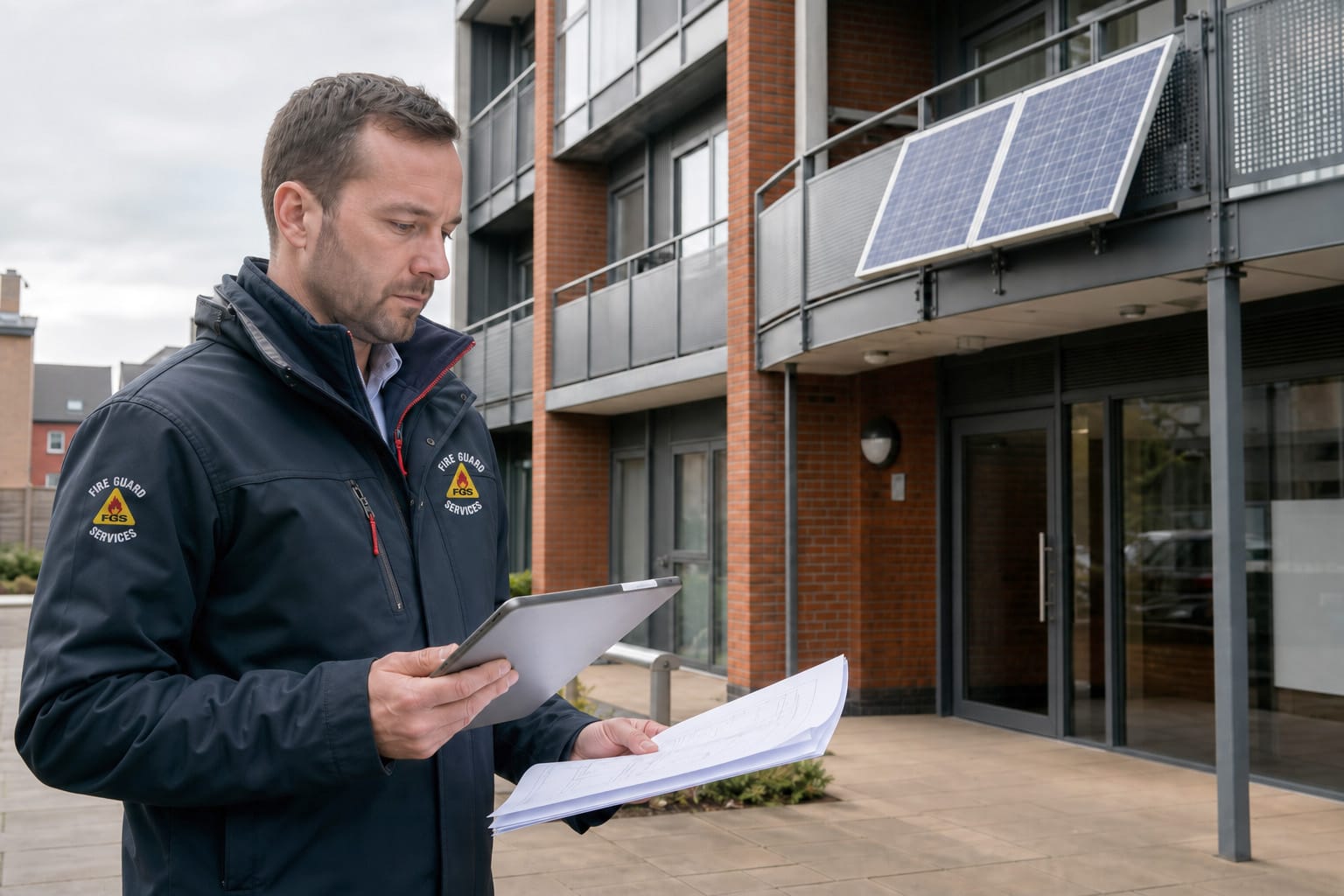
Plug-in solar has the potential to make renewable energy available to many more households. Used correctly, a compliant product in a suitable property can be a positive addition.
But its simplicity at the point of use must not disguise the wider considerations. The condition of the wiring, the position of the panel, external-wall construction, escape routes, management arrangements and emergency response all matter.
Homeowners should check before they connect. Landlords and building managers should establish a controlled approval process. Businesses should not assume that a domestic product specification applies to commercial premises.
Fire Guard Services can help landlords, responsible persons and organisations review how solar equipment affects their fire risk assessment, detection and warning arrangements, firefighting equipment, emergency lighting, signage and staff training.
If plug-in solar is being considered for your property or has already appeared without being included in the fire-safety arrangements, contact Fire Guard Services for professional advice.
This article provides general fire-safety information and is not a substitute for property-specific electrical, planning, legal or fire-risk advice. Requirements and technical guidance may continue to develop as the new market becomes established.