
Fire protection services
Fire Door Inspections & Certification Audits
Protect escape routes and compartmentation with professional fire door inspections, clear reports and practical remedial advice.
Fire Guard Services audits fire doors for landlords, managing agents, facilities teams and businesses across London and the surrounding counties.
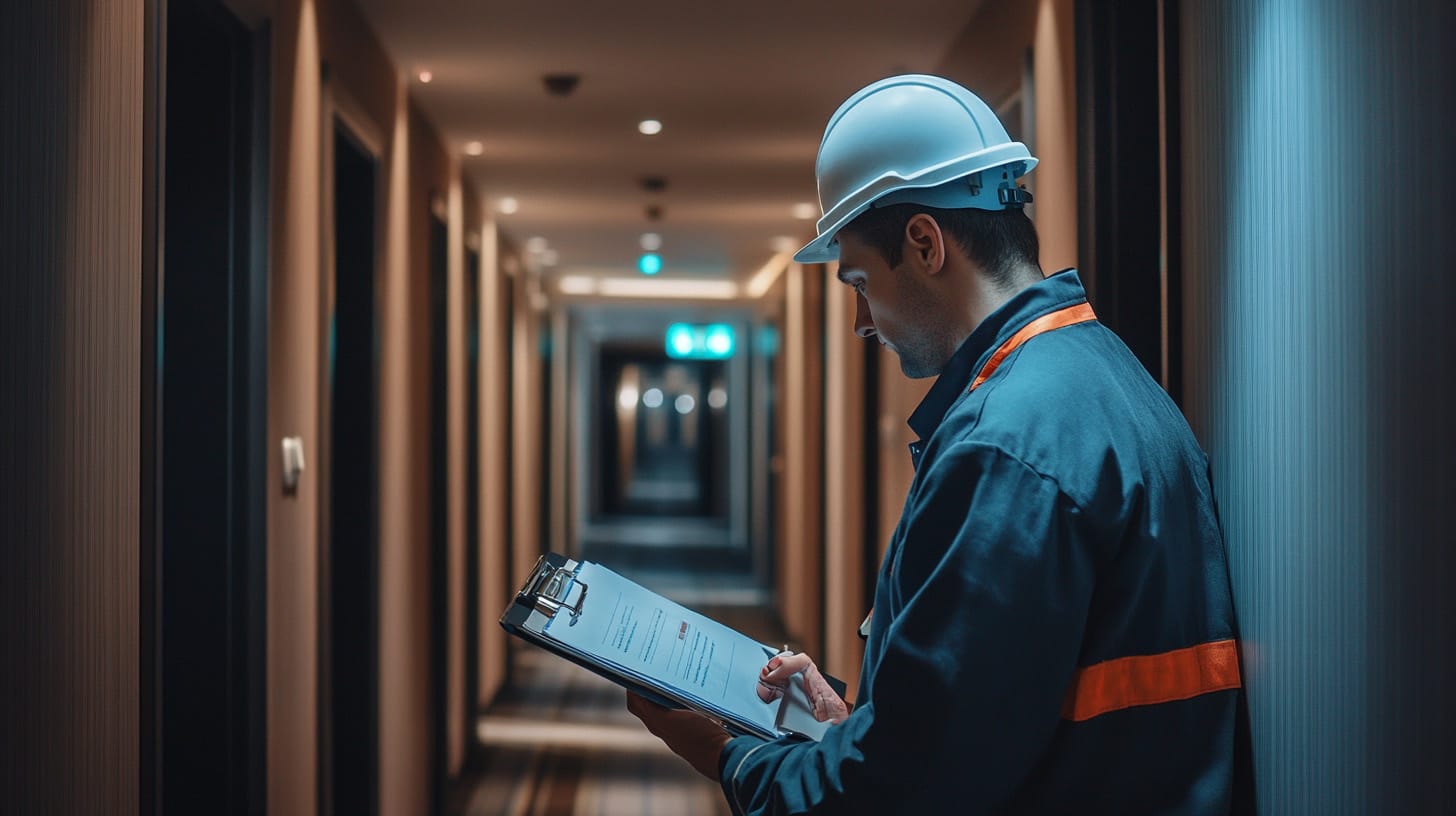
Detailed inspection reports
Clear findings and prioritised actions
Why fire doors matter
A closed, well-maintained fire door can protect lives.
Fire doors form part of a building’s passive fire protection. When correctly specified, installed and maintained, they help restrict fire and smoke, preserve protected routes and give occupants more time to escape.
Protects compartments
Helps contain fire and smoke within designated areas of the building.
Safeguards escape routes
Supports safer evacuation by resisting smoke and fire entering protected routes.
Finds defects early
Identifies damage, excessive gaps, failed closers and unsuitable alterations.
Creates an audit trail
Provides clear records to support maintenance planning and fire safety management.
What we inspect
The complete fire door assembly, not just the door leaf.
A fire door depends on every component working together. Our inspection records the door’s condition and highlights defects requiring maintenance, further assessment or replacement.
Door leaf and frame
We check for visible damage, distortion, unsuitable alterations and compatibility between the leaf and frame.
Gaps and clearances
We assess gaps around the perimeter and threshold against the evidence and requirements applicable to the door.
Closers and operation
We confirm that self-closing devices operate and that the door closes fully into the frame without obstruction.
Seals and glazing
Where fitted, strips, smoke seals, glazing and grilles are checked for damage, paint or signs of unsuitable work.
Hinges and hardware
Hinges, locks, latches, hold-open devices and other ironmongery are reviewed for condition and suitability.
Signs and records
We check relevant signage and identifiers, then document findings so actions can be tracked to completion.
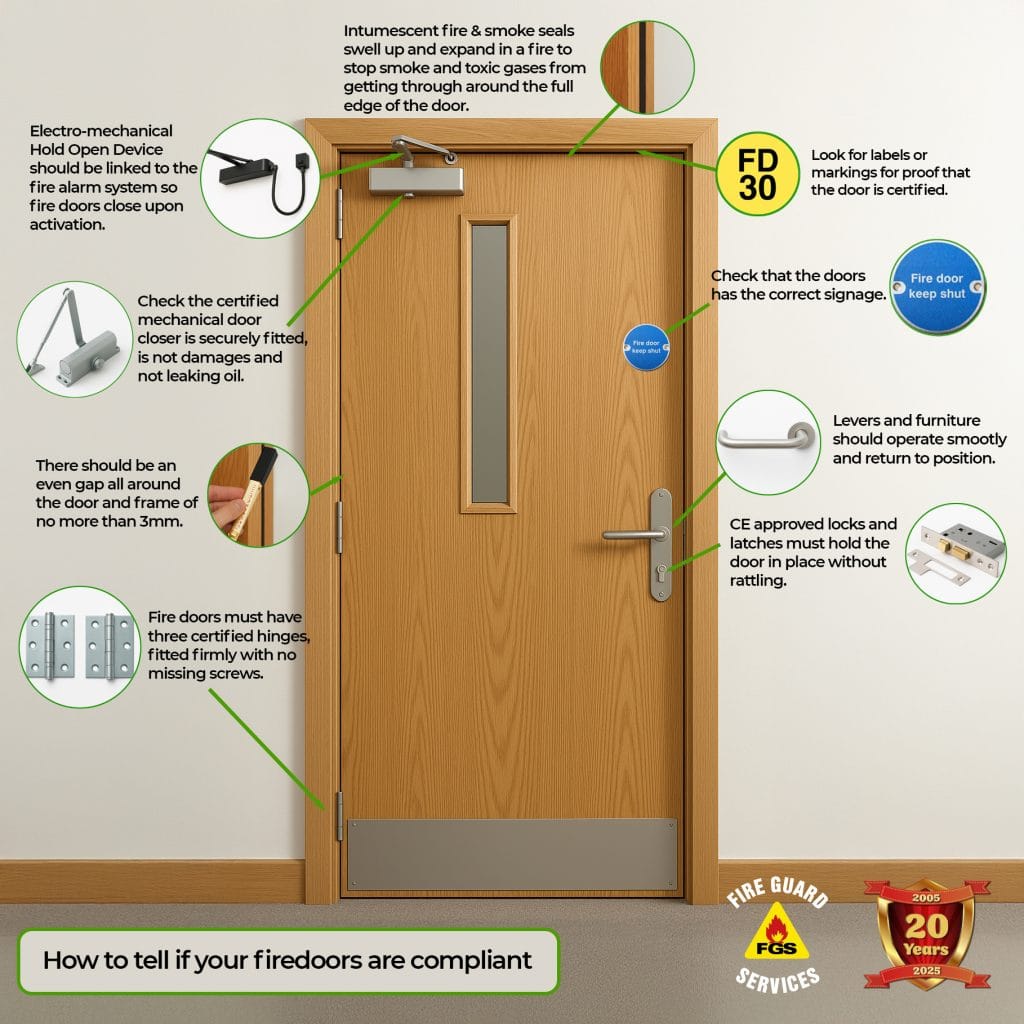
Fire door inspection guide
Seven important checks for a fire door.
This quick visual guide highlights common points to look at, including certification markings, gaps, seals, hinges, glazing, signs and self-closing action.
Important: A visual check can identify obvious issues, but it does not replace a competent inspection or the building’s fire risk assessment.
Checks and inspections
Routine checks and competent inspections have different jobs.
Frequent visual checks help identify day-to-day damage or operational faults. A detailed inspection records the full assembly and supports informed decisions about maintenance and remedial work.
Routine visual check
- Look for obvious damage or alteration
- Confirm the door closes fully into the frame
- Check that seals and hinges appear intact
- Report and act on faults promptly
Competent fire door inspection
- Examine and identify the complete assembly
- Measure gaps and assess components
- Record each door and photograph defects
- Prioritise remedial recommendations
Residential building duties
Specific checks apply in multi-occupied residential buildings over 11 metres.
Under the Fire Safety (England) Regulations 2022, responsible persons must use best endeavours to check flat entrance fire doors at least every 12 months and check fire doors in communal areas at least every three months where the top storey is more than 11 metres above ground level.
These routine checks complement rather than replace the building’s suitable and sufficient fire risk assessment.
Updated government guidance
A risk-based approach
Existing flat entrance doors do not automatically require replacement simply because they lack modern certification, strips or seals. Their adequacy should be determined through the fire risk assessment, taking condition, performance and context into account.
If components are present, routine checks should confirm they remain undamaged and effective.
Our process
From door schedule to clear remedial priorities
We make fire door audits straightforward, with an agreed scope, systematic inspection and practical reporting.
01
Step 01
Confirm the scope
We discuss the premises, door numbers, available records and the reason for the inspection.
02
Step 02
Inspect each door
Our inspector works systematically through the agreed door schedule and records condition and defects.
03
Step 03
Issue the report
You receive an accessible record of doors inspected, findings and recommended action priorities.
04
Step 04
Plan remedial work
We explain the findings and can help plan suitable repairs, maintenance or replacement where required.
Need confidence in your fire doors?
Tell us about your building and the number of doors for practical advice from our team.
What our clients say
Trusted fire safety support for businesses and property teams
Who we support
Fire door inspections for workplaces, residential buildings and public premises.
We support responsible persons, landlords, managing agents and facilities teams responsible for individual sites and multi-building portfolios.
Practical compliance support
Clear records for every inspected door
Our reports help you understand defects, prioritise remedial work and maintain a useful audit trail.
Automotive
Support fire safety across showrooms, workshops, storage areas and customer-facing dealership spaces.
Car Dealerships
Help protect high-value vehicles, workshops, staff areas and showroom environments.
Care Homes
Support vulnerable residents, staff training, evacuation planning and safe day-to-day care environments.
Distribution & Logistics
Assess warehouses, depots, loading areas, storage risks and operational fire safety arrangements.
Education
Fire risk assessment support for schools, nurseries, colleges, universities and multi-building sites.
Facilities Management
Practical support for facilities teams managing fire safety across complex buildings and sites.
Healthcare
Help protect patients, staff and visitors in clinical, care and healthcare environments.
HMOs/Landlords
Fire safety support for HMOs, shared houses and rented homes. Coordinate assessments, alarms, fire doors, maintenance and remedial work.
Hospitality
Review fire safety risks across guest areas, kitchens, staff spaces and high-occupancy premises.
Hotels
Review guest rooms, escape routes, kitchens, communal areas and staff procedures.
Housing Associations
Help manage fire safety responsibilities across residential buildings, communal areas and tenant spaces.
Lettings Agencies
Support landlords and property managers with rental properties, HMOs and managed blocks.
Places Of Worship
Support safe, accessible spaces for worship, community use, events and shared facilities.
Property Management
Support fire safety compliance across managed buildings, communal areas and multi-property portfolios.
Public Sector
Practical fire risk assessment support for public buildings, community facilities and local authority premises.
Residential/Domestic
Practical fire safety support for homeowners and residents, including smoke detection, fire alarms, electrical checks and fire doors.
Retail
Help protect customers, staff, stock and trading areas with clear fire safety recommendations.
Visitor Attractions
Assess public-facing environments, visitor routes, staff areas, cafés, exhibitions and event spaces.
Do not see your sector?
We protect businesses across every industry – from corner shops to hospitals.
FAQs
Fire Door FAQs
Straightforward answers to common questions about fire door checks, inspections, certification and maintenance.
What is a fire door inspection?
A fire door inspection is a systematic check of the complete door assembly, including the leaf, frame, gaps, seals, hinges, closer, glazing and other hardware. The findings are recorded so defects and remedial priorities can be managed.
How often should fire doors be inspected?
The right frequency depends on the building, use, condition and fire risk assessment. In multi-occupied residential buildings where the top storey is more than 11 metres above ground level, the Fire Safety (England) Regulations 2022 require communal fire doors to be checked at least every three months and flat entrance fire doors at least every 12 months on a best-endeavours basis.
What should be checked on a fire door?
Checks commonly include visible damage, gaps around the leaf, the frame, hinges, self-closing device, latch, seals, glazing, signage and any alterations. The door should close fully into the frame without obstruction. The exact assessment should reflect the door and the building.
Do older fire doors without certification need replacing?
Not automatically. Updated government guidance explains that an existing flat entrance door is not necessarily unfit simply because it lacks modern certification, intumescent strips or smoke seals. Its adequacy should be determined through the fire risk assessment, considering its condition, performance and context.
What is the difference between FD30 and FD60 fire doors?
FD30 and FD60 describe fire-resistance periods of 30 and 60 minutes under the relevant test evidence. The required rating and any smoke-control designation must be determined for the door’s location, building design and fire strategy.
Can a fire door be repaired instead of replaced?
Many defects can be repaired by competent people using suitable, compatible components, but repair is not appropriate in every case. The inspection findings and available evidence should guide whether maintenance, further assessment or replacement is needed.
Do you provide a report after the inspection?
Yes. We provide a clear record of the doors inspected, identified defects and recommended priorities, helping you plan remedial work and maintain an audit trail.
Who is responsible for fire doors?
The responsible person must ensure suitable fire precautions are provided and maintained for premises covered by the Fire Safety Order. In residential buildings, the duty may sit with a freeholder, landlord, managing agent or other person with control of the common parts.
Check your area
Do We Provide Fire Door Inspections In Your Area?
Enter your UK postcode to check local availability for this service. We also support larger organisations with multiple locations across the UK, so contact us about wider requirements.